General Zulfikar
Midnight's ChildrenGeneral Zulfikar is a military power broker whose household becomes a stage for political change and whose public authority is ultimately undone by the private history of his crimes. As Saleem’s uncle and Zafar’s father, he helps Ayub Khan seize control of Pakistan; years later, his concealed smuggling operations and responsibility for the crisis at the Rann of Kutch come to light, and Zafar kills him. His story binds the novel’s intimate family conflicts to the making, narration, and suppression of national history.
Identity and Household
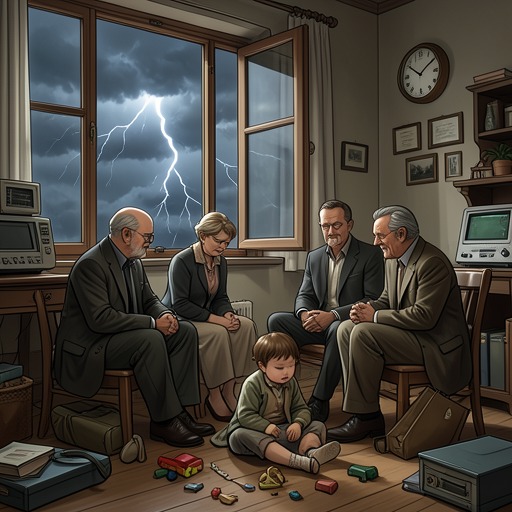
General Zulfikar lives in Rawalpindi in a large house enclosed by a high wall topped with barbed wire and patrolled by sentries. The household is organized around military discipline: the servants wear green military jerseys and berets, a bath stands beside the double bed in which the General sleeps, and the recurring household phrase is “Let’s get organized!” The controlled domestic setting reflects both his rank and his insistence on order.
Saleem enters this household as a relative and observer. The General’s daughter Emerald travels with him, while his son Zafar is also Saleem’s cousin. The family setting gives Saleem a close view of the contrast between Zulfikar’s formal authority and the humiliations and vulnerabilities that shape his relationship with his son.
Seizure of Power
During the political crisis that brings Ayub Khan to power, the novel places Saleem close to the decision-making. Ayub addresses the men around him and announces that he is taking control of the state. General Zulfikar is poised to explain the procedures, but the disruption caused by Zafar’s bed-wetting draws the General’s anger and breaks the moment of military composure. Zulfikar sends his son from the room and then turns to Saleem for help.
The ensuing account makes the division between strategic command and symbolic participation deliberately unstable. Zulfikar describes troop movements, while Saleem moves pepperpots, saltcellars, serving spoons, bowls, and other tableware to represent units and locations. The mustard jar stands for Company A occupying the Head Post Office; pepperpots and a serving spoon signify Company B taking the airport. When the General stops speaking, Saleem’s miniature campaign ends as well. Ayub praises Zulfikar’s performance, and Saleem later says that what began with pepperpots ended with a government overthrown and a president sent into exile. The scene gives the child an improbably consequential place in a political transition while showing Zulfikar as its practical military organizer.
Father and Son
Zulfikar’s authority at home does not translate into an ability to command his son. When Zafar wets himself during the political gathering, the General expels him and insults him; the episode exposes Zafar’s long-standing vulnerability in front of his father. Zulfikar then looks to Saleem to help restore the family’s honor. The exchange makes Saleem a temporary substitute within a strained father-son relationship, and foreshadows how Zafar’s accumulated shame will eventually turn against the General.
The novel later connects Zafar’s childhood humiliations and lifelong bed-wetting to his return to the family home in July 1965. By then he also knows that his father was responsible for the events at the Rann of Kutch, where Zafar himself had been reduced to a state of terror. The personal grievance and the political discovery converge: the son approaches his father’s bedroom carrying both the memory of the household’s treatment of him and knowledge of the General’s actions.
Smuggling and Death
The later revelation overturns the public image of Zulfikar as merely a military official. The novel identifies him as the commander behind smuggling convoys that crossed the unguarded Rann and carried goods into Pakistani cities. It also says that his fortune began with the suffering of Hindu families fleeing in 1947 and was enlarged by these later operations. The Rann episode that had left Zafar terrified was therefore not simply a border incident: it was connected to his father’s illicit enterprise.
In Rawalpindi, Zafar finds his father beside the bath in his bedroom and kills him with a smuggler’s knife. The account treats the death as both a family catastrophe and the exposure of a political secret. Zafar is imprisoned; the novel also notes that his imprisonment spares him from a marriage he did not want. General Zulfikar’s removal does not produce a clear public reckoning: reports recast the border events as a repelled Indian invasion and the deaths of Pakistani soldiers as an Indian massacre, while his smuggling activities remain obscured from the public account.
Public Record and Narrative Role
Zulfikar’s career is presented through a persistent tension between what is officially reported and what Saleem’s retrospective narration claims to know. After his death, the newspapers’ account of the Rann events conflicts with the concealed story of the General’s payments to border guards and smuggling network. The narrator stresses that accounts that seem plausible may still differ from the official version, making Zulfikar’s career an example of how power can shape the public record.
His death also connects the Rann conflict to the larger war that follows in August 1965. The novel describes the earlier events as kindling for that broader violence and places them within Saleem’s story of a history that repeatedly turns private lives into national consequences. At the novel’s end, General Zulfikar returns among the crowd of figures pressing around Saleem as his body breaks apart. The recurrence keeps the General present not as a living authority but as part of the accumulated family and political past from which Saleem cannot escape.